Overview
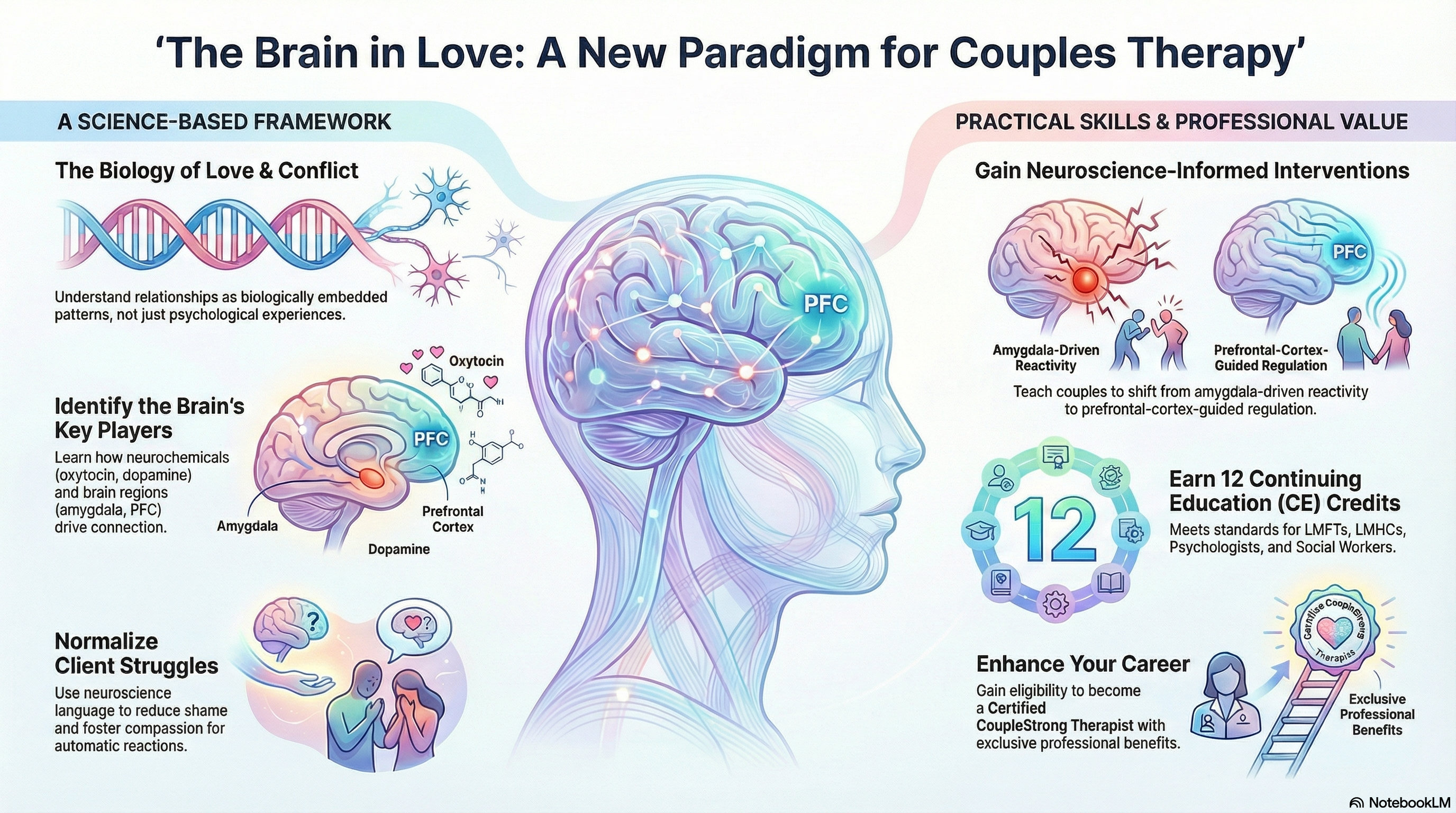
The Neuroscience of Love is a groundbreaking clinical training that integrates neuroscience, biology, and relationship science to transform the way therapists approach couples work. Rather than relying solely on communication strategies, this training dives deep into the brain’s circuitry, the body’s bonding and stress systems, and the evolutionary forces that shape attachment.
Therapists will learn to explain love and conflict not just as psychological experiences but as biologically embedded patterns that can be understood, normalized, and reshaped. This science-based perspective equips clinicians with tools to reduce shame, foster compassion, and implement interventions that align with the nervous system’s natural capacity for connection and healing.
By completing this program, therapists gain a practical framework for helping clients rewire patterns of disconnection, repair attachment injuries, and build resilient intimacy. The result is therapy that is more effective, research-informed, and deeply transformative for the couples you serve.
Learning Objectives
Upon completion of this training, participants will be able to:
- Explain the role of key neurochemicals (oxytocin, dopamine, cortisol, serotonin, vasopressin) in attachment, bonding, and conflict.
- Identify the brain regions most relevant to love, stress, and emotional regulation (e.g., amygdala, prefrontal cortex, hippocampus, insula) and their impact on relational dynamics.
- Apply neuroscience-based language to normalize couples’ struggles and reduce client shame.
- Demonstrate how evolutionary biology has shaped human pair bonding and its relevance to modern relationships.
- Incorporate rituals of connection and evidence-based practices that stimulate bonding pathways and reduce stress responses.
- Teach couples strategies for shifting from amygdala-driven reactivity to prefrontal-cortex-guided regulation in moments of conflict.
- Integrate neuroscience into assessment, conceptualization, and treatment planning for couples in therapy.
- Use neuroscience-informed interventions to enhance intimacy, rebuild trust, and sustain long-term attachment.
Continuing Education (CE) Credits
Participants who complete this training will earn 12 Continuing Education (CE) credits. This course meets professional development standards for Licensed Marriage and Family Therapists (LMFTs), Licensed Mental Health Counselors (LMHCs), Psychologists, Social Workers, and related mental health professionals.
Professional Value
Completion of The Neuroscience of Love not only enhances a therapist’s clinical skillset but also positions them at the forefront of biologically informed couples therapy. Graduates are eligible to apply these hours toward becoming a Certified CoupleStrong Therapist, gaining exclusive benefits such as professional recognition, discounted access to the national therapist listing, reduced training fees, and ongoing membership benefits within the CoupleStrong network.
Overview
The Neuroscience of Love is a groundbreaking clinical training that integrates neuroscience, biology, and relationship science to transform the way therapists approach couples work. Rather than relying solely on communication strategies, this training dives deep into the brain’s circuitry, the body’s bonding and stress systems, and the evolutionary forces that shape attachment. Therapists will learn to explain love and conflict not just as psychological experiences but as biologically embedded patterns that can be understood, normalized, and reshaped. This science-based perspective equips clinicians with tools to reduce shame, foster compassion, and implement interventions that align with the nervous system’s natural capacity for connection and healing. By completing this program, therapists gain a practical framework for helping clients rewire patterns of disconnection, repair attachment injuries, and build resilient intimacy. The result is therapy that is more effective, research-informed, and deeply transformative for the couples you serve. Learning Objectives Upon completion of this training, participants will be able to:
- Explain the role of key neurochemicals (oxytocin, dopamine, cortisol, serotonin, vasopressin) in attachment, bonding, and conflict.
- Identify the brain regions most relevant to love, stress, and emotional regulation (e.g., amygdala, prefrontal cortex, hippocampus, insula) and their impact on relational dynamics.
- Apply neuroscience-based language to normalize couples’ struggles and reduce client shame.
- Demonstrate how evolutionary biology has shaped human pair bonding and its relevance to modern relationships.
- Incorporate rituals of connection and evidence-based practices that stimulate bonding pathways and reduce stress responses.
- Teach couples strategies for shifting from amygdala-driven reactivity to prefrontal-cortex-guided regulation in moments of conflict.
- Integrate neuroscience into assessment, conceptualization, and treatment planning for couples in therapy.
- Use neuroscience-informed interventions to enhance intimacy, rebuild trust, and sustain long-term attachment.
Continuing Education (CE) Credits Participants who complete this training will earn 12 Continuing Education (CE) credits. This course meets professional development standards for Licensed Marriage and Family Therapists (LMFTs), Licensed Mental Health Counselors (LMHCs), Psychologists, Social Workers, and related mental health professionals. Professional Value Completion of The Neuroscience of Love not only enhances a therapist’s clinical skillset but also positions them at the forefront of biologically informed couples therapy. Graduates are eligible to apply these hours toward becoming a Certified CoupleStrong Therapist, gaining exclusive benefits such as professional recognition, discounted access to the national therapist listing, reduced training fees, and ongoing membership benefits within the CoupleStrong network.
Course Content

